
The Old Schvitz on Pico: The Forgotten History of Pico-Burnside Baths
The story of the historic Los Angeles bathhouse that became City Spa & Health Center.

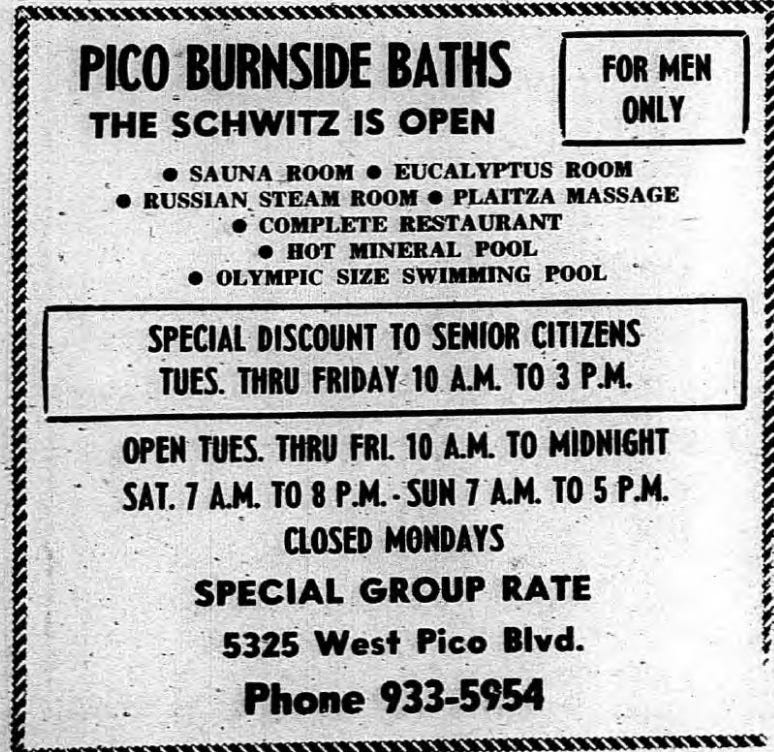
Pico-Burnside Baths, 1973. Advertisement from the B’nai B’rith Messenger, April 20, 1973.
At 5325 W. Pico Boulevard, an old Russian-Jewish bathhouse survived the changing city around it, helped inspire one of L.A.’s strangest magazines, and eventually became City Spa. I’ve been walking through its doors for 25 years.
Los Angeles has a habit of erasing itself.
Restaurants disappear. Neon signs come down. Familiar buildings are demolished or remodeled beyond recognition. A place you drove past for thirty years can vanish on a Tuesday, and by Friday there’s plywood around it and a rendering of luxury apartments taped to the fence.
But every once in a while, something survives.
At the corner of Pico Boulevard and Burnside Avenue, a few blocks east of Fairfax, there is one of those places.
Today the sign says City Spa & Health Center. But long before that name appeared, generations of Angelenos knew 5325 W. Pico Boulevard as Pico-Burnside Baths.
I’ve been going there for 25 years.
For most of those years, I didn’t think of myself as visiting a historical site. I went because I liked the place: the punishing heat, the cold plunge, the steam, the swimming pool, the food, the characters and that unmistakable feeling that once you walked through the doors, you had temporarily left Los Angeles outside.
Only later did I realize that every time I went there, I was stepping into a surviving piece of old Jewish Los Angeles.
And the deeper I dug into its history, the stranger—and more quintessentially L.A.—the story became.
Before City Spa, There Was Pico-Burnside
The Los Angeles Times dates the opening of Pico-Burnside Baths to 1955. Los Angeles’ SurveyLA historic-resources project dates the building itself to 1956 and identifies the property at 1374 S. Burnside Avenue and 5319, 5321 and 5325 W. Pico Boulevard as Pico Burnside Baths.
SurveyLA considered the property historically significant as the founding and longtime location of the baths, noting its long association with a Jewish clientele. (Los Angeles Times)
The one-year discrepancy between 1955 and 1956 may simply reflect the difference between the founding of the business and completion or recording of the building. Until an opening advertisement, building permit or city directory turns up, 1955–56 is probably the safest way to describe its beginning.
The location couldn’t have been more appropriate.
By the postwar years, Jewish Los Angeles had been moving westward from Boyle Heights and the neighborhoods around downtown. Pico-Fairfax developed into one of the centers of Jewish life in the city—a landscape of synagogues, kosher markets, bakeries, delis, restaurants and businesses serving families that had migrated west.
Into that world came a Russian-style bathhouse.
Not a Beverly Hills spa.
A shvitz.
“THE SCHWITZ IS OPEN”
One of the best artifacts I’ve found from the old Pico-Burnside survives in an unlikely place: the pages of the B’nai B’rith Messenger.
On April 20, 1973, the Jewish newspaper carried a display advertisement for the baths.
And it is wonderful.
PICO BURNSIDE BATHS
THE SCHWITZ IS OPEN
In a box in the upper-right corner was another message:
FOR MEN ONLY
The advertisement offered a sauna room, eucalyptus room, Russian steam room, platza massage, complete restaurant, hot mineral pool and an “Olympic Size Swimming Pool.”
There were discounted weekday hours for senior citizens. The place stayed open until midnight Tuesday through Friday, opened at seven in the morning on weekends and closed Mondays.
Then, at the bottom:
5325 West Pico Blvd.
Phone 933-5954
That advertisement tells us a lot.
By 1973, Pico-Burnside wasn’t disguising itself with the language of beauty treatments or luxury wellness. It was advertising directly to readers of a Jewish newspaper and proudly announcing itself as “THE SCHWITZ.”
Even the spelling has charm.
And then there’s that telephone number.
Today City Spa still occupies 5325 W. Pico Boulevard.
Its phone number still ends in 933-5954.
The city changed its area codes. The neighborhood changed. The name of the bathhouse changed.
The number survived.
What Was a Shvitz?
The Yiddish shvitz literally means “sweat,” but the traditional bathhouse was about much more than getting hot.
For generations of Eastern European Jewish immigrants, the public bathhouse was a place to wash, steam and prepare for the Sabbath, but it was also a social institution. The Los Angeles Times later described the shvitz as a popular ritual among Russian and immigrant Jews. (Los Angeles Times)
You went to get hot. Really hot.
Then cold.
Then hot again.
You talked. You ate. You rested. You played cards. You argued. You cooled off. Then you went back into the steam room and started over.
There was also the platza—sometimes spelled plaitza—in which bundles of leafy branches are soaked and used on the body in the intense heat of the steam room.
To an outsider it can look vaguely medieval.
To someone who loves a Russian bath, it makes perfect sense.
The old Pico-Burnside wasn’t particularly glamorous, either.
And that would eventually attract a very different group of Angelenos.
Then the Artists Arrived
In the mid-1970s, artist and architecture student Leonard Koren was experimenting with projects he called “Bath Art.”
Koren needed a way to thank the friends and artists who had modeled for him. He didn’t have much money, so rather than paying everyone a few dollars, he decided to throw them a party.
A friend suggested Pico-Burnside.
Koren later remembered discovering a funky, rundown Russian-Jewish bathhouse with mismatched wall finishes and lingering smells of Eastern European delicatessen food. (The Slowdown)
In other words, it was perfect.
There was a problem.
Pico-Burnside was a men’s bathhouse.
Men and women bathing together was absolutely forbidden.
Koren asked anyway.
Eventually the management relented. He later recalled paying $450 to take over the entire facility for the evening—the sauna, two steam rooms, swimming pool, whirlpool, changing and snack areas and weight room—on the condition that everybody was out by midnight. (Invention of Desire)
Think about that scene for a moment.
An old Russian-Jewish shvitz on Pico Boulevard.
Artists.
Designers.
Movie people.
Bathing suits.
Naked people.
Fully dressed people talking to naked people.
Food.
Steam.
And an electric jazz violinist wandering around the bathhouse.
It sounds less like something that actually happened and more like the setup to a lost Robert Altman movie.
But this was Los Angeles in the 1970s.
Koren intentionally left his invitations vague, so guests weren’t quite sure what they were supposed to wear—or what exactly was going to happen. He later remembered the resulting confusion as creating tremendous “social energy.” (Yahoo)
And out of that steamy night on Pico came something nobody could have predicted.
WET: The Magazine of Gourmet Bathing
After the party, Koren started thinking about how to capture the energy he had stumbled onto.
His answer was a magazine.
In 1976 he launched WET: The Magazine of Gourmet Bathing.
If the title sounds ridiculous, that was part of the point.
WET became an eccentric mixture of bathing, art, design, fashion, architecture, humor and Los Angeles counterculture. It eventually attracted contributors and subjects ranging across the creative world.
Koren has been explicit about where it began:
The idea grew out of the Pico-Burnside bath party. (LA Review of Books)
And there’s photographic evidence.
The first issue of WET, published in May/June 1976, contains Paddy Reynolds’ poolside photographs from that first party at Pico-Burnside. Those photographs remain preserved in the magazine’s official online archive. (WET the magazine of gourmet bathing)
Pico-Burnside didn’t disappear from the story after that first night, either. The surviving WET archive contains posters and announcements for later WET parties at the bathhouse. (WET the magazine of gourmet bathing)
It’s one of my favorite collisions in Los Angeles history.
An institution descended from Eastern European Jewish bathing culture somehow became a gathering place for the city’s experimental art and design crowd.
Old-world Pico-Fairfax met 1970s California.
Steam apparently made a good introduction.
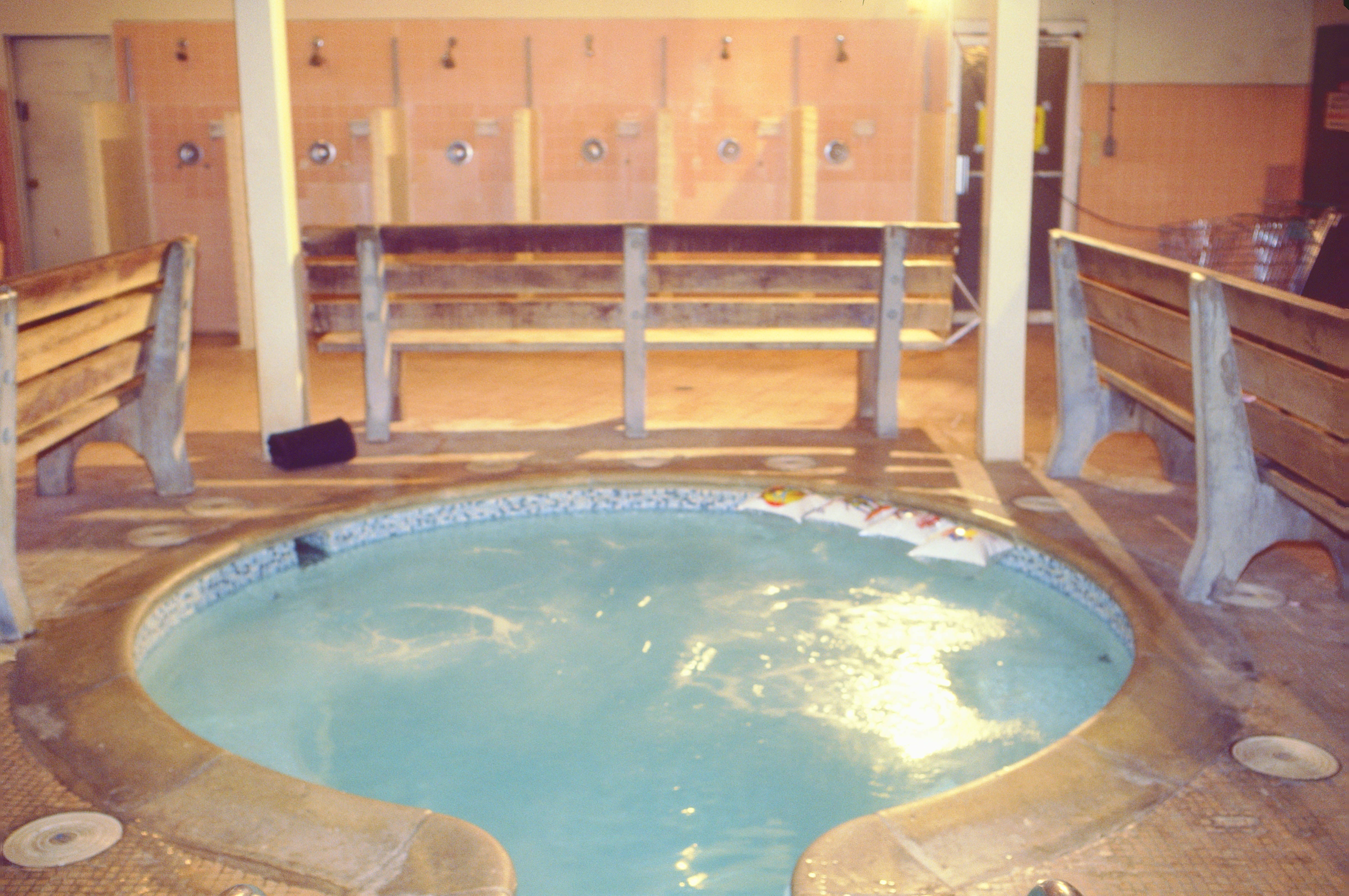
Inside Pico-Burnside Baths, circa 1978
The Missing Years
There is still a mystery at the center of the Pico-Burnside story.
Who originally owned it?
The evidence I’ve found establishes the baths by the mid-1950s, but I haven’t yet found a reliable document identifying the original proprietor.
We do have an intriguing later name.
A California business record shows Pico Burnside Baths, Inc. at 5325 W. Pico Boulevard, incorporated on January 31, 1978.
Its president was listed as Ellis Passovoy. (BizStanding)
That doesn’t establish that Passovoy founded the baths.
Quite the opposite: if the Times‘ 1955 opening date is correct, the establishment had already been operating for more than twenty years when the corporation was created.
Passovoy could have been an owner who came later. The original operation might have been a partnership or sole proprietorship before incorporation. He could also have been associated with the business earlier than 1978.
For now, that’s one piece of the puzzle still waiting to be solved.
Somewhere there may be a 1950s telephone directory, building permit, photograph, newspaper advertisement or yellowed business record with the answer.
1989: Pico-Burnside Becomes a New Kind of Shvitz
The ownership trail becomes much clearer in 1989.
According to the Los Angeles Times, Kambiz Besharat and his brothers purchased the bathhouse that year and extensively remodeled it.
Besharat owned the neighboring wood-flooring business. The Times described him as an Iranian Jew of Russian heritage who remembered spending afternoons shvitzing with his father when he was a boy. (Los Angeles Times)
Over time, Pico-Burnside became City Spa & Health Center.
The clientele broadened. Women and coed bathing periods became part of the operation. The place increasingly attracted people from outside the old neighborhood and outside the Jewish community.
But the basic ritual survived.
Heat.
Steam.
Cold water.
Platza.
Swimming.
Food.
Conversation.
Sitting around doing absolutely nothing for a while.
Then getting hot all over again.
My 25 Years at City Spa
I’ve now been going to City Spa for about a quarter of a century.
When I started going there, I wasn’t conducting historical research.
I wasn’t thinking about SurveyLA or old Jewish newspapers or Leonard Koren.
I just liked the place.
There was something genuine about it—slightly worn, eccentric, communal and completely uninterested in being fashionable.
Los Angeles has plenty of places where you’re supposed to be seen.
City Spa always struck me as a place where you went to disappear for a few hours.
You walked in from Pico Boulevard, changed clothes, and gradually surrendered to a different rhythm.
Steam.
Cold.
Swim.
Sit.
Eat.
Talk.
Steam again.
After enough rounds, the traffic outside might as well have been in another city.
And after 25 years, I realize that this is probably not so different from what attracted people to Pico-Burnside decades before I ever walked through its doors.
Ghosts in the Steam
There is a little L.A. noir in the story if you look for it.
Not the Raymond Chandler kind with a revolver in a desk drawer and a black Packard waiting at the curb.
Something quieter.
Imagine Pico Boulevard after dark in 1973.
The old storefronts are illuminated by signs. Cars hiss over the pavement. Somewhere down the block there’s a deli still open. Behind an anonymous door at 5325 W. Pico, men are sitting half-naked around a table, eating and arguing while clouds of eucalyptus steam roll through another room.
Someone disappears into the Russian steam.
Someone dives into the pool.
Someone gets a platza.
Outside, Los Angeles keeps reinventing itself.
Inside, nobody seems particularly concerned.
A few years later, artists and designers invade the place for a night, an electric violin echoes through the steam, somebody from the Los Angeles Times shows up, photographs are taken around the pool, and eventually an odd little magazine called WET emerges from the whole thing.
Then the artists leave.
The bathhouse remains.
That’s the part I love.
The Shvitz Is Still Open
Pico-Fairfax isn’t the neighborhood it was in 1955.
Much of the Jewish commercial world that once defined this part of Pico has disappeared or moved elsewhere.
Pico-Burnside could easily have disappeared with it.
Instead, the name changed.
The owners changed.
The clientele changed.
The building changed.
But people kept coming to 5325 W. Pico Boulevard to sweat.
I’ve been one of them for 25 years.
And now, when I walk through City Spa, I can’t help thinking about everyone who came before me.
The Russian and immigrant Jewish men who treated the shvitz as part bathhouse, part social club.
The senior citizens who might have clipped that discount advertisement from the B’nai B’rith Messenger in 1973.
Ellis Passovoy, whose precise place in the story we’re still trying to understand.
Leonard Koren and his artists taking over the bathhouse for a night.
The Besharat brothers arriving in 1989 and giving the old place another life.
And thousands of anonymous Angelenos who walked through the same address, sat in the heat, jumped into cold water and went home feeling somehow different than when they arrived.
There’s something else I keep returning to.
That old advertisement from April 20, 1973.
PICO BURNSIDE BATHS.
THE SCHWITZ IS OPEN.
5325 West Pico Blvd.
933-5954.
More than half a century later, the address is still 5325 W. Pico.
The phone number is still 933-5954, now preceded by an area code.
And after 25 years of going there myself, I’ve come to appreciate how unusual that kind of continuity is in Los Angeles.
Some history gets landmark plaques.
Some gets preserved behind velvet ropes.
Some survives only in photographs and newspaper clippings.
And occasionally, if you’re lucky, the old place is still there.
You can walk in off Pico Boulevard.
You can get hot.
You can get cold.
And you can still shvitz.
Author’s note: This history is still a work in progress. One question I hope to answer is who founded and operated Pico-Burnside Baths during its earliest years in the 1950s and ‘60s. If you remember the old Pico-Burnside, worked there, knew its owners, or have photographs, advertisements or stories from the bathhouse, I’d love to hear from you.
Love this piece, a cool companion to our own obsession with the recently shuttered, even older Turkish bath house last known as KLYT at 4th & Los Angeles in Skid Row. Looked your bath house up on LADBS and can answer some of your questions. Original owner Meyer Wiesberg (home address 14012 Davana Terr., Sherman Oaks) hired architect Avon Pitman and licensed engineer Sigmund Levin to construct Steam Baths in early 1956. Wiesberg got his Certificate of Occupancy on 1/21/1957.